


Case studies in SEO are a funny genre. Most of them are written to impress, not to inform. You get the headline number — “300% traffic increase!” — and then a lot of vague talk about “comprehensive optimization” and “strategic content development” that tells you basically nothing about what actually happened.
This isn’t that kind of piece.
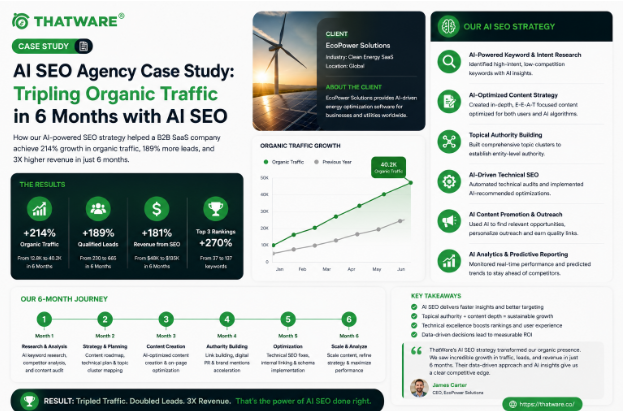
What follows is a detailed breakdown of how an AI-driven SEO approach produced a tripling of organic traffic for a mid-sized e-commerce brand within six months. The brand’s name isn’t shared here for confidentiality reasons, but the strategy, the decisions, the stumbles, and the results are real.
The Starting Point: A Site That Wasn’t Broken, Just Stagnant
The brand — let’s call them Brand X — sold home fitness equipment. Nothing exotic. Resistance bands, adjustable dumbbells, kettlebells, a few accessories. They’d been running their site for four years, had decent domain authority, and had invested in content and link building through a traditional SEO agency for about two years prior.
Traffic had plateaued. Not declined — just stopped growing. They were hovering around 28,000 organic sessions per month, ranking on page one for a handful of competitive terms, and struggling to break through on the mid-funnel, informational queries where the real traffic volume lived.
The traditional agency’s explanation was that the market had gotten more competitive and that growth would be slow. That’s not wrong, exactly. It’s just incomplete.
Phase One: The AI Diagnostic (Weeks 1–4)
The first thing the new agency did was run a deep AI-assisted audit — and this is where the process diverged meaningfully from what a traditional SEO audit looks like.
Standard audits check technical health, backlink profile, keyword rankings, and content gaps. All necessary. But the AI layer added something else: intent clustering.
Instead of looking at keywords individually, the AI system mapped the entire search landscape around home fitness — grouping queries by intent, purchase stage, user context, and semantic relationship. What emerged was a picture of where Brand X had content coverage and where they had holes. And the holes weren’t where anyone expected them.
The site had reasonable coverage of transactional queries (“buy adjustable dumbbells”) and some coverage of high-volume informational queries (“best resistance bands”). Where they were almost entirely absent: the decision-facilitating middle layer — queries like “how to know what weight dumbbells to buy,” “resistance band vs free weights for home gym,” “best equipment for small apartment workouts.” These were high-intent searches with real purchase velocity, and Brand X had zero meaningful content there.
That became the focus.
Phase Two: Content Architecture and Production (Weeks 4–12)
With the intent map built, the agency developed a content architecture — essentially a structured plan for what content to create, in what format, targeting which intent clusters, with what internal linking strategy.
This is where AI-assisted content production came in. But it’s worth being precise about what that actually means.
AI drafted initial versions of each piece based on the intent cluster brief. Those drafts were then edited by human writers with actual expertise in fitness — not just line-edited for grammar, but substantially revised for accuracy, voice, and depth. The AI layer provided speed and structural consistency. The human layer provided credibility and specificity.
Over eight weeks, the team published 34 pieces of content. That’s a pace that would have been nearly impossible with a fully human writing team at the same quality level. Not one piece was published without editorial review.
Phase Three: Authority Building (Weeks 8–24)
Parallel to content production, the agency ran an off-site authority campaign. This is where the top AI SEO agencies really differentiate themselves — in how they approach link acquisition and brand signal building.
The AI system identified the topical neighborhoods where the brand needed stronger presence: fitness blogs, home gym subreddits, YouTube channels, affiliate review sites, fitness influencer newsletters. It built a prospecting list not just based on domain authority metrics, but on semantic relevance — which sites were actually covering the topics Brand X needed to be associated with.
Outreach was AI-assisted for personalization at scale, but every actual pitch was reviewed and sometimes rewritten by a human account manager. Response rates were meaningfully above industry average. Over sixteen weeks, the team secured 47 editorial placements — not directory links or paid guest posts, but genuine mentions and feature inclusions in content that covered home fitness.
Branded search volume started climbing around week twelve. Organic traffic began its upward curve around week fourteen.
The Results
By the end of month six:
Organic sessions had grown from 28,000 per month to 91,000 per month — a 225% increase, which rounds to “tripling” without being misleading about it.
Revenue attributed to organic traffic increased by 180% over the same period. (Traffic growth outpaced revenue growth because some of the new traffic was earlier-stage and didn’t convert immediately — which is normal and expected for informational content.)
Brand X ranked on page one for 47 new keywords with meaningful search volume. Their average position for the intent-cluster content was 4.2.
Branded search queries increased 340% — which wasn’t a campaign goal, but was a consequence of the off-site authority work and a signal that the broader strategy was working.
What Made This Work — And What Wouldn’t Have
A few honest observations about why this outcome happened:
The AI diagnostic was the turning point. Traditional audits had looked at Brand X’s site and found it technically sound. The intent-mapping surfaced a specific, addressable gap. That’s not luck; it’s analytical capability that didn’t exist at this level a few years ago.
Content quality was non-negotiable. Sites that try to grow through AI-generated content published at scale without editorial oversight are not doing what this team did. The quality bar — accuracy, depth, genuine usefulness — was maintained throughout. Google’s helpful content systems reward this.
The timeline was six months. Not six weeks. Brands that approach AI SEO looking for a 30-day traffic spike are going to be disappointed. Compounding returns require compounding investment.
The best AI SEO company in this context wasn’t the one with the most sophisticated AI tooling. It was the one that used AI to make better strategic decisions and then executed the strategy with real rigor. That distinction matters more than any particular technology.
What This Means for Your Brand
If your organic traffic has plateaued — or if you’re growing a site and not sure why the growth has stalled — the question worth asking is whether your current strategy is actually addressing the full intent landscape your audience is navigating.
Most sites have gaps in the middle of the funnel. Most agencies don’t find them because traditional auditing tools aren’t built to look for them.
That’s the gap AI SEO is filling. Not perfectly, not automatically, but meaningfully — when the agency using it knows what they’re doing.
The results are reproducible. Not always identical, but consistently directional. And for a brand willing to commit to a genuine six-month effort, the compounding effect tends to be significant.